A 2020 COPO Camaro was built to honor drag racing legend John Force. It debuted at the 2019 SEMA Show and was sold at the 2020 Barrett-Jackson Scottsdale auction, with proceeds donated to charity. In addition to its distinctive appearance, the car featured a supercharged, LSX-based 350 engine.
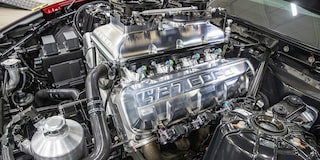
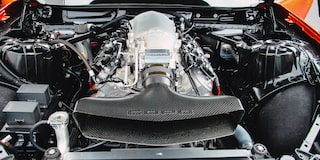
This is the engine of the last COPO Camaro produced — car number 69 of the 2023 production run. Like the original 1969 COPO Camaro ZL-1 models, it is an all-aluminum and naturally aspirated Big Block engine displacing 427 cubic inches, but in place of a carburetor is a pair of EFI throttle bodies.
Offered throughout the fifth and sixth generations of the F-body, the COPO Camaro race car program built on the legacy of the original 1969 special-order models that were intended for a single purpose: winning on the drag strip. Decades later, the COPO program produced race cars from 2012-23.
Every COPO Camaro was hand-built to the customer’s specifications, with an extensive range of available powertrain and supporting components, including the engine, transmission, rear axle and more. Additionally, each car was built from a factory Body in White and constructed with racing-certified safety features.
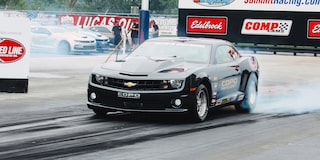
Longtime racer Jerry Noonan (top) has been a COPO Camaro competitor since acquiring his first one — a Gen 5 model — in 2013. His stable of race cars now includes four of the hand assembled COPO models. He’s seen here at the 2023 COPO Camaro Shootout, in Ohio, squaring off with a four-generation Camaro.
In its final year, the 2023 COPO Camaro was offered with a racing version of the ZZ632/1000 crate engine. Still available for hot rods, resto-mods and other project vehicles, the ZZ632/1000 is the largest, most powerful crate engine every from Chevrolet. It offers 1,004 horsepower on 93-octane pump gas.
Between 2012 and 2023, more than 800 COPO Camaro race cars and rolling chassis models (without powertrains) were constructed. Racers could select from a range of engines throughout the years, including naturally aspirated and supercharged versions, all developed by Chevrolet engineers to durable performance.
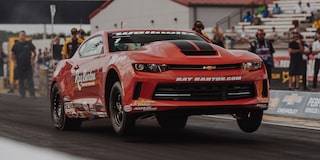
Aaron Stanfield is another seasoned COPO Camaro racer — and his car is quick. With hard, wheels-up launches, the black Janac Brothers Camaro runs in the mid-7-secondrange at around 165 miles per hour. It’s performance that has helped earn the competitor multiple race wins.
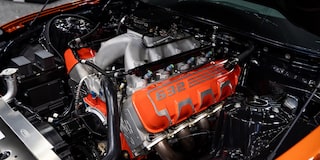
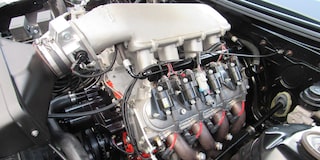
In 1969, the original COPO Camaro were built with special-order 427-cubic-inch engines that weren’t offered in regular production models. It was the same with the COPO racing program, which included several 427-inch engines over the years such as the LSX-based engine seen here.
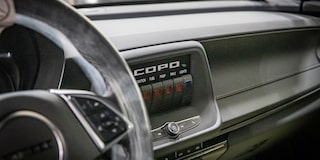
Among the many unique components developed for the COPO program, a control panel was designed to fit in the binnacle for the radio — an unnecessary accessory in a dedicated race car.
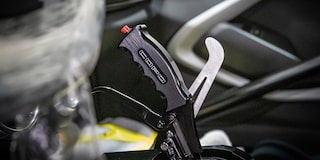
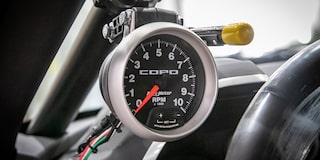
A tachometer (with shift light) is shown, mounted to the roll cage of a COPO Camaro. The chassis for each car was constructed to suit the specifications for a variety of Stock class drag racing series. In addition to the powertrain elements, Chevrolet developed a portfolio of supporting racing components.
Every COPO Camaro race car and rolling chassis was built at special assembly facility in Oxford, Michigan. Updates and improvements were made each year, based on the feedback and experiences of the fraternity of racers that has come to be known as the “COPO family.”
One of the most significant differences between the production models and the bespoke COPO race cars was the use of a “stick” rear axle rather than an independent rearend. It allowed racers to use proven, racing-strength solid axles that enabled more consistent performance — especially on a hard launch.
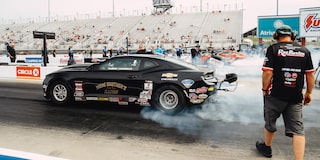
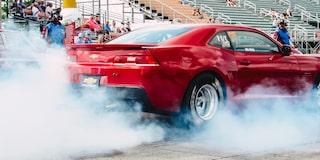
A Gen 5 COPO Camaro heats up the rear tires in the important burnout phase prior to the start of a race. The heat helps the soft-compound racing slicks grip the track’s launch pad, minimizing or preventing tire spin that costs precious time in a race that could be decided in hundredths or thousandths of a second.
Naturally aspirated and supercharged engines were options for each year of the COPO program, with the naturally aspirated engines found mostly in the Stock and Super Stock classes and the supercharged COPO engines powering competitors in the Factory Stock Showdown and Factory Super Car classes.
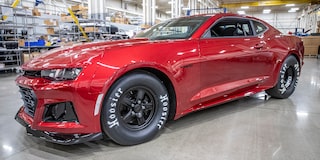
This 2023 COPO Camaro is the last one constructed. It pays homage to the 1969 COPO model campaigned by Chevy Dealer Fred Gibb, which was red and featured a 427 engine with a high-rise intake and dual carburetors. This tribute also has a high-rise manifold and a pair of EFI throttle bodies.